Posts

Showing posts with the label be informed

Old Tech - New Tech (part 2)

Image
In my previous article, I described how I used a Card Method to gather input from my audience for a Smart Documentation solution. My approach for these sessions was: I prepared approximately 20 cards with topics from the current version of the system I invited 18 respondents for a 30 minutes session The sessions consisted of three parts: To start with, I asked every respondent to make five cards for the five topics that they would like to find on the new system. By narrowing it down to five, I encourage them to only write down the most important topics. At the end of this step I asked them to make categories of these five cards, each category forming a column on the table. In the next step I - one by one - gave them the prepared topics and asked the respondent to add them to an existing category or create a new category for it. When all cards were done, we reviewed the categories and made final adjustments In the final step, the respondent wrote down the labels for the categor...

Old Tech - New Tech

Image
Sometimes you need to fall back on the oldest technologies available to get the most out of the latest and greatest. This is also true when developing smart documentation. My current project involves the creation of a smart documentation solution for the Be Informed Business Process Platform (BPP). The documentation solution is targeted at users with various educations levels, different skills and experiences and with various roles in an organization or project. And to make things even more complex: the total set of documentation should at least cover all current versions of the BPP, the business solutions that are used on top of it and the implementation and project management methods used during implementation. Preparation  As mentioned in my white paper about creating smart documentation, the preparation for a smart documentation project - before writing the content - consists of the following steps: Define the goal, audience, and context: Clearly define the context, g...

Smart documentation revisited

Image
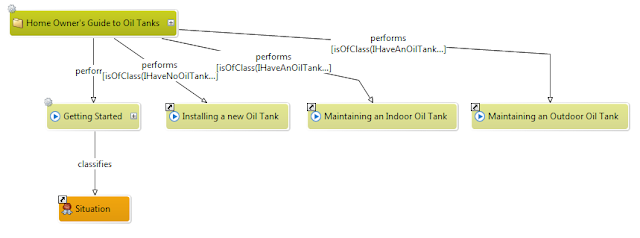
At the STC Summit 2013 in Atlanta, I demonstrated how we can create smart documentation by using semantic technology. The session was well visited and there were a lot of good questions. During the session I modeled live - together with the audience - on a smart maintenance manual for oil tanks. To me - being from a country where we don't know or use these kind of tanks next to our houses - this felt like the ultimate example, completely relying on the expertise of my audience. The demo The starting point was a very basic procedure, consisting of four main activities: In the first step we determine the situation. We start with a short situation description and then - instead of describing what possible situations there are and linking to the pages - we ask our users about their situation. As it is not relevant for people that don't own an oil tank yet to read the maintenance instructions, the first question we ask is whether or not the reader actually owns an oil tan...

Improve Product and Brand engagement through smart documentation

Image
There is no doubt that the introduction of semantic technology in documentation, will change the way we create our documentation. Increased product and brand engagement Figure 1. Happier users Smarter documentation will lead to happier users, who reach their goals faster and with less frustration. Documentation that exactly responds to individuals will enhance perception of the product and the brand. Although positive feedback travels less quickly on the social media than negative feedback, it will not only impact the product and brand engagement of current customers but also motivate potential customers to take a serious look at your product. It will also influence your image and reputation as a technical communicator in the market and the value you offer to your contractors or managers. In this perspective technical communication will become a profit center instead of a cost center.   Increased documentation engagement Figure 2. Continuity of work Lookin...

Documentation as a Service

A knowledge-based, semantically-modeled process can provide exactly the right result for end users and a powerfully effective tool for working teams in an organization. An additional benefit comes with the semantic solution for documentation: the ability to generate multiple output forms in multiple languages and addressed to different audiences from one set of models and content. User manuals, reference documentation, contextual help, in-context explanations, on-line user-assistance and complete inter- and intranet sites can be generated from one single repository, consisting of the relevant models and references to the content. Generating multiple documentation forms is one step in the process of providing documentation as a service. We can take it even one step further by integrating all these output forms in one smart user assistant. The smart user assistant adapts to events, answers questions, gives advice and assists in completing tasks. The key is computing with knowledge in t...

Model first, write later

Image
The use of models fits perfectly in the professional approach of creating user documentation: Define the goal, audience, and context: Clearly define the context, goals, and audiences. The design of documentation should be goal-driven—from the user’s point of view. Often, a brown paper or moderation session will help you define these goals and requirements. Involving users in this first step helps them understand the process and gives them an ownership stake in the solution. Create models of the goals, models and other important context factors and discuss them with the involved users. Analyze processes and activities: This is an important step in creating goal-driven documentation and should lead to a model of all relevant processes and activities. Also define the roles of different users within the processes.   Create the overall documentation model: this phase involves creating an overall structure for the product information, as well as linking this product model to the pr...

Using semantic technology in a model-driven environment

Image
Reaching a smarter form of documentation requires that we start to develop other strategies for displaying knowledge even as we change how we gather and store it. Among the solutions we can offer to accomplish this smarter form of documentation are combinations of non-hierarchical navigation, faceted navigation, decision trees, wizards, and faceted search. But first we have to break our habit of hierarchical structuring all our content in chapters, sections, and subsections. Many web sites, manuals and help systems share this structure: all content elements are sub-themes of an element on the preceding level. Figure 1. Many web sites, manuals and help systems are build up like a book with chapters, paragraphs and sub-paragraphs A hierarchical, structured approach is optimized for the most informed users: the developers and designers who created the product. The path it indicates would be the most direct route to becoming an expert user of the product. But for users who need to ...

The business case for smart documentation

Image
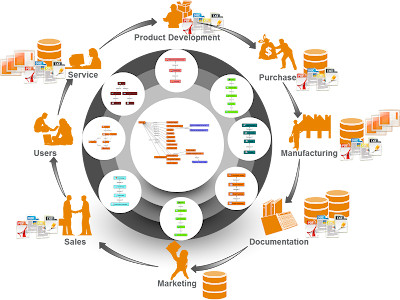
In my previous posts I have focused on the benefits of semantic technology in documentation for end users. Semantic technology also offers a great opportunity to support the documentation creation and revision process. Semantic technology replaces a disconnected, post-hoc documentation routine with a dynamic process that is easily deployed, tested, reviewed and revised. Every relevant stakeholder can be involved in the documentation process, as users and as authors. Smart documentation builds internal engagement for the organization in the same ways that it builds external engagement in the customer base. The modular re-use and incremental revision of documentation will reduce total cost of documentation. Support all parties in the product life cycle Using semantic technology in documentation makes it possible to optimize Product Life Cycle Management: It can support all documentation processes for all parties in the product life cycle. It also enables the re-use of information an...

From flexible content to digital knowledge

Image
Digital technology has allowed the documentation process to evolve from single document-centric to single source-centric: From creating individual manuals to creating re-usable chunks of information for a series of product and document types through various channels. Figure 1. Documentation evolved from document centric to single source centric Example A manufacturer of agricultural machines needed a complete line of documentation for its new type of harvester. In a document-centric approach, this would mean having one technical writer create the user documentation, another writer create the service manual and a third create the on-line help. In the best case they would copy chapters or paragraphs from one manual to the other. All of these documentation types would need to be reviewed by hand and individually updated when the harvester’s features changed, or new rules for its safe operation were implemented. In a single source environment, multiple writers work on discrete top...

Get documentation superpowers: Send me (a chapter of or instruction from) your documentation

As announced on several social media, I will demonstrate how we can use semantic technology to create process-driven documentation at the STC Summit 2013 in Atlanta.  I will do this by live modeling with a semantic tool set. Now I could do this with a predefined demo set, but what's the fun of that? So I would like to invite you to send a delimited instruction - this could be a chapter from one of your manuals - by uploading it to our server. From the uploaded manuals, I will select one or more to be modeled out.  As the models in the semantic environment are instantly executable, we can watch the documentation develop, change the models and review the results in a web browser. Wouldn't it be cool to see your documentation modeled out on the large screen at the STC Summit? When: May 6th, 2:00 pm (EDT) Where:   Hanover FG, Hyatt Regency Atlanta - Track my session Level: Advanced Uploading your file   Go to http://info.beinformed.com/stc13-upload a...

Improving product and brand engagement

Image
Instruction manuals, users guides, and other types of documentation have always been the way manufacturers distributed the how-to information about their products to customers, as well as sales and support staff and other employees. This kind of catch-all, one-size document forces every user to sift through irrelevant information, applying their own context to find solutions to their problems. Even when they are successful, users remember the experience as painful and tedious. What if you could take each individual user by the hand and guide them through the product, showing only what is relevant in their situation, immediately answering their questions and helping them make decisions and choices? Seamlessly effective, customized support would improve the user’s experience of the product and help them to feel engaged by the product and its brand. Product and brand engagement Product and brand engagement is – a partly emotional, partly rational – process of forming an attachment...

Proving the benefits of model driven business applications in an unsettled budgetary climate

Image
  "In the current budgetary climate it is getting harder and harder to prove the benefits case for a new business application to my organization ." Origin of this myth I found this statement on several forums on the Internet. While software companies will do their best to persuade their potential customers in getting their latest software, for internal architects and analysts it is often a struggle to get things started within their own organization. In the current economic situation most CEO's and CFO's are not exactly waiting for big investments in new ICT systems, even if their internal specialists can come up with the right arguments. So how to deal with this? The classic approach is to come up with a calculation of profit and cost, based on past experiences of other organizations in the same industry and the quick wins that you see within the own organization. A cost - profit analysis is - without any doubt - a necessity when proposing a new business appl...

Lessons learned from being a virtual booth crew member

Image
Live modeling through a live connection -  bridging the approximately 4650 miles between Apeldoorn in the Netherlands and Hollywood in Florida - that is not something you see (or do) everyday. The original plan was simple: go to the Building Business Capabilities conference in Florida and create a model driven business application on the fly, based on the input of the audience. Due to the impact of the hurricane Sandy, our flight to the US was canceled and we were unable to perform this plan on the exhibition floor. Fortunately our team had the equipment and the determination not to give up and instead we came up with this innovative alternative: Modeling live in our office in Apeldoorn Using join.me to share our screens with the visitors of our booth Using a Skype video connection to interact with the visitors of our booth. So what did we learn from this experience? The good Performing our live modeling exercise remote offered some major advantages: Travel costs ...

Working with requirements

Image
"In engineering , a requirement is a singular documented physical and functional need that a particular product or service must be or perform. It is most commonly used in a formal sense in systems engineering , software engineering , or enterprise engineering . It is a statement that identifies a necessary attribute, capability, characteristic, or quality of a system for it to have value and utility to a user." Source: Wikipedia During the Building Business Capabilities conference 2012 in Fort Lauderdale, we are going to develop a working model-driven business application, based on the input provided by the audience. And although this will be in a "lab" situation, we want to stay as close to a real life situation as possible. And then working with requirements is an essential element. Both requirements and the Be Informed modeling artifacts (models, profiles, custom meta models) are aimed at the same goal: allowing the stakeholders of the system to ...