Posts

Showing posts with the label technical communcation

Writing effective articles 6: Don’t be hasty

Image
As a writer I am always eager to get my articles published. Unfortunately – like with all processes – speeding up things often has a negative effect on the end quality of your product. Taking the time for a serious QA step, pays of in a more effective article. There are two processes that you can use to improve the quality of your article: Review process Pre-test process In an ideal situation you do them both. Get reviewed Although most of us are excellent writers, capable of delivering the message to an audience, it is always a good idea to set up a review process for your article before you post it on your blog or send it in to a magazine. A review process in an ideal world consists of two activities: A peer review by someone who knows the topic: technology, method or issue; A grammar & style review by a trained editor. For the peer review it is important to always provide the goal and audience definition to the reviewers, so they know what you are a...

Writing Effective Articles: 3. Pick Your Audience

Image
In the previous blog posts, we have talked about the criteria for effective articles and how important it is to set a goal before you start. Now suppose you have decided to write an article about new technology that enables organizations to perform better and make more profit. The goal of your article is to persuade the reader to come to one of the conferences where your company demonstrates this new technology. Would you be interested to hear what your neighbor – a software engineer – thinks of this article? Or the gardener? Or your kids? The audience is part of the goal Aim at a specific audience and define them If you write an article that is supposed to generate new opportunities for your organizations, you are typically aiming at decision makers within a specific industry. So while your neighbor – the software developer – can find your article too shallow and lacking the technical details he is looking for, your targeted audience of decision makers could possible find it...

Old Tech - New Tech

Image
Sometimes you need to fall back on the oldest technologies available to get the most out of the latest and greatest. This is also true when developing smart documentation. My current project involves the creation of a smart documentation solution for the Be Informed Business Process Platform (BPP). The documentation solution is targeted at users with various educations levels, different skills and experiences and with various roles in an organization or project. And to make things even more complex: the total set of documentation should at least cover all current versions of the BPP, the business solutions that are used on top of it and the implementation and project management methods used during implementation. Preparation  As mentioned in my white paper about creating smart documentation, the preparation for a smart documentation project - before writing the content - consists of the following steps: Define the goal, audience, and context: Clearly define the context, g...

Get documentation superpowers: Send me (a chapter of or instruction from) your documentation

As announced on several social media, I will demonstrate how we can use semantic technology to create process-driven documentation at the STC Summit 2013 in Atlanta.  I will do this by live modeling with a semantic tool set. Now I could do this with a predefined demo set, but what's the fun of that? So I would like to invite you to send a delimited instruction - this could be a chapter from one of your manuals - by uploading it to our server. From the uploaded manuals, I will select one or more to be modeled out.  As the models in the semantic environment are instantly executable, we can watch the documentation develop, change the models and review the results in a web browser. Wouldn't it be cool to see your documentation modeled out on the large screen at the STC Summit? When: May 6th, 2:00 pm (EDT) Where:   Hanover FG, Hyatt Regency Atlanta - Track my session Level: Advanced Uploading your file   Go to http://info.beinformed.com/stc13-upload a...

Improving product and brand engagement

Image
Instruction manuals, users guides, and other types of documentation have always been the way manufacturers distributed the how-to information about their products to customers, as well as sales and support staff and other employees. This kind of catch-all, one-size document forces every user to sift through irrelevant information, applying their own context to find solutions to their problems. Even when they are successful, users remember the experience as painful and tedious. What if you could take each individual user by the hand and guide them through the product, showing only what is relevant in their situation, immediately answering their questions and helping them make decisions and choices? Seamlessly effective, customized support would improve the user’s experience of the product and help them to feel engaged by the product and its brand. Product and brand engagement Product and brand engagement is – a partly emotional, partly rational – process of forming an attachment...

Back to technical writing

After working for 2,5 years as Information Advisor and ICT Architect, I had the opportunity to return to the things that I do best: writing, structuring information (modelling) and designing knowledge solutions. Within a few weeks I will start as Knowledge Analyst / Technical Writer at Be Informed in Apeldoorn, the Netherlands. Be Informed and Technical Communication Be Informed is an internationally operating, independent software vendor. I have worked with them from early 2006 until the end of 2008, as an external contractor. The Be Informed business process platform supports administrative processes, that are becoming increasingly knowledge-intensive. The role of technical documentation in this process should not be underestimated. What if we could provide our users with exactly the information they need to perform their task at exactly the right moment. The information could come from various sources (manuals, websites, on-line help) and could involve combinations of software doc...

Documentation 3.0

In my last blog I explained how we can distinguish three phases in the development of documentation. The first phase was a very product centric one, while in the second phase we see a more process driven approach. Re-use gets more and more important as is collaboration with other writers. But what about the users? How do they benefit from this move to single sourcing? Sure, creating and translating documentation becomes cheaper and easier to manage, but having documentation in your own language is for most people normal and not seen as a usability feature. And then there is the issue with information overload. Maybe we should ask our users what information they need, instead of just providing them with everything we want them to know. To really help our users, we should move on from our process centric approach to a more customer-centric one. A customer-centric approach Documentation 3.0 is all about offering the right documentation at the right time. It is customer-centric, which mea...

Technical writers as information integrators

Image
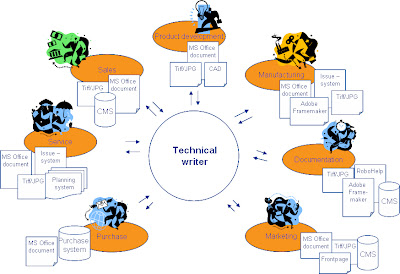
In an earlier post, I compared my work as a technical writer with Island hopping: going from one island to another. The truth is that to perform our job well we need information from different sources within an organization. And on the other hand people from different parts of the organization have a need for our skills when it comes to writing and presenting information. In a way we therefor function as information integrator within the organization: gathering information from different platforms and sources and creating output for different depatments (internal customers) and in different formats. As an example: When I created the documentation for my current customer, I gathered information about the product from different deparments and developed the on-line help. As a result, the Sales department became aware of my presence, noticed the quality of the information and asked me to create the Sales information. Currently I am working on a structure for the product specifications. In ...

New article in Intercom

Image
In March 2008 my new article "The Flexible Intranet" will be published in Intercom, the monthly magazine of the Society for Technical Communication. In this article I will examine the typical problems found in a corporate intranet site and demonstrate how knowledge-driven design can improve the effectiveness of intranet sites. In the article I use the example of a helpdesk that delivers support for mobile phones. With this example I will demonstrate how an effective intranet site guides the helpdesk employee toward the information and presents the answers to the questions they are confronted with. Saul Carliner, an internationally known expert on technical communication, contributed to this article. Intercom, the magazine of the Society for Technical Communication , is published to provide examples and applications of technical communication that will promote its readers' professional development. Intercom is published for the benefit of STC members, each of whom receives...