Posts

Showing posts with the label ISTC

An Open Framework for Technical Communicators?

Image
In the previous post I mentioned that creating user-oriented documentation requires an understanding of the audience and its tasks and processes. The trick has always been that it is hard to explain the days or weeks spend on audience and task analysis, while it doesn't deliver a visible contribution to our work from the start. There also isn't a real method or framework - that we can refer to - that demands the activities and deliverables that come with an audience and task analysis. In this a rea we can learn from ICT Architects , especially when it comes to: Usage of a common and widely accepted framework like DYA or TOGAF Development of standard notation methods, like Archimate for creating models of the different architectural layers of a solution Visibility of all activities and models in the end result. Standards versus an Open Framework A fact is that there are standards for documentation, but they are more or less focused on the quality of the end product and not on t...


Documentation 3.0

Image
The trends in documentation of the past 20 years are under heavy influence of the development of internet technology. Like with the web – where we distinguish between Web 1.0, Web 2.0 and 3.0 - we can see three phases in documentation. I will call them Documentation 1.0, Documentation 2.0 and 3.0. Where Documentation 1.0 is - like Web 1.0 - very much centered on individual products and information, brings Documentation 2.0 a process-driven approach with a focus on re-use. The customer-driven approach of Documentation 3.0 is a logical next step. But why should we change the way we create documentation? First of all the world is changing and so are our users! Things that seem obvious to one individual, don't make any sense to others. Take for instance this photo (shown to the left). It shows a young model holding a camera. In her perception, you hold a compact camera this way. Truth is that she is holding a 1970's Olympus Pen EE-3, a camera with a viewfinder instead of a LCD scr...

Article "How knowledge becomes usable" in Communicator

Image
In my article "How knowledge becomes usable" - published in the Winter edition of Communicator - I explain how you can incorporate knowledge-driven design in information products. The Communicator is the quarterly journal of the Institute of Scientific and Technical Communicators (ISTC). The article is a follow-up on my presentation at the ISTC Conference 2007 in Liverpool. If you are a member or a subscriber of Communicator, you automatically receive this issue. Otherwise, if there is something of interest to you, contact the ISTC Office to purchase a copy. The ISTC is the largest UK-based society for professional communicators. If you are a technical communicator and working in the UK - or Europe in general - I can strongly recommend membership of the ISTC. Look for more information on their website: www.istc.org.uk .

Documenting product development

Image
I mentioned in my last article of 2007, that as a technical writer you can expect to be asked for several kinds of documentation within your organization. Recently I started to structure the product requirements and product specifications of my customer's products. The intended audience consists of the product manager and product architects on the one hand and the developers on the other hand. The goal of my work is to create a knowledge bank in which the audience can see both the product requirements and the relevant specifications next to each other. At this moment there are two types of documents: A functional requirements document: This is a 27 pages long Word document, including some illustrations. It has a thematical structure. This document is written and edited by two product architects. Component design documents: These are detailed functional and technical descriptions of parts of the product, first written by developers and then edited by two functional designers. The co...

Technical writers as information integrators

Image
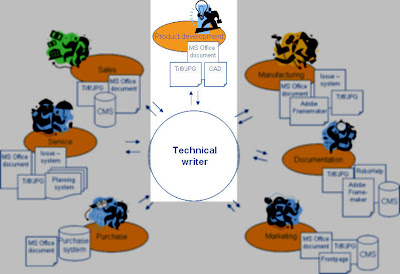
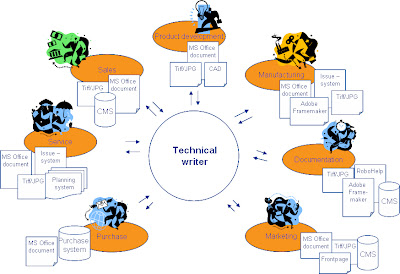
In an earlier post, I compared my work as a technical writer with Island hopping: going from one island to another. The truth is that to perform our job well we need information from different sources within an organization. And on the other hand people from different parts of the organization have a need for our skills when it comes to writing and presenting information. In a way we therefor function as information integrator within the organization: gathering information from different platforms and sources and creating output for different depatments (internal customers) and in different formats. As an example: When I created the documentation for my current customer, I gathered information about the product from different deparments and developed the on-line help. As a result, the Sales department became aware of my presence, noticed the quality of the information and asked me to create the Sales information. Currently I am working on a structure for the product specifications. In ...

About knowledge modelling: Why do we need it?

Image
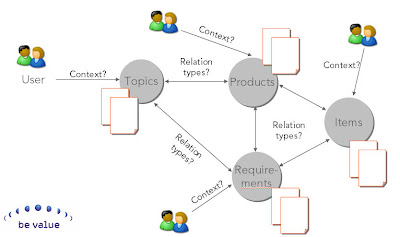
In my article in ISTC's Communicator (Autumn 2007) I explained that developing more effective information products asks for a knowledge-driven approach to communication. This knowledge-driven approach requires first of all that we offer the knowledge needed in a usable and understandable way, in line with the user’s knowledge and level of experience. The second requirement is that we should offer our users the right knowledge - from the enormous amount of available knowledge – at the right time. New semantic technology provides us with the opportunity to support our users in interpreting information within their context. The most important characteristics of these solutions are: non-hierarchical navigation: presents a mind map of the information, with different types of links making it possible to browse quickly through related topics and offering different points of view to different types of users decision trees: help users to make complex decisions by asking them simple question...

New article in Communicator

Image
Yesterday I received the author's proof of my article "How knowledge becomes usable", scheduled for publication in the Winter edition of Communicator, the quarterly journal of the Institute of Scientific and Technical Communicators (ISTC). This article is a follow-up on my presentation at the ISTC Conference 2007 in Liverpool, where I explained how you can incorporate knowledge-driven design in information products. The Winter edition of Communicator will be published in December 2007. If you are a member or a subscriber of Communicator, you will received this issue when it is published. Otherwise, if there is something of interest to you, contact the ISTC Office to purchase a copy. The ISTC is the largest UK-based society for professional communicators. If you are a technical communicator and working in the UK - or Europe in general - I can strongly recommend membership of the ISTC. Look for more information on their website: www.istc.org.uk .