Posts

Showing posts with the label user manual

Improving product and brand engagement
Image
Instruction manuals, users guides, and other types of documentation have always been the way manufacturers distributed the how-to information about their products to customers, as well as sales and support staff and other employees. This kind of catch-all, one-size document forces every user to sift through irrelevant information, applying their own context to find solutions to their problems. Even when they are successful, users remember the experience as painful and tedious. What if you could take each individual user by the hand and guide them through the product, showing only what is relevant in their situation, immediately answering their questions and helping them make decisions and choices? Seamlessly effective, customized support would improve the user’s experience of the product and help them to feel engaged by the product and its brand. Product and brand engagement Product and brand engagement is – a partly emotional, partly rational – process of forming an attachment...
Lessons learned from ICT Architecture

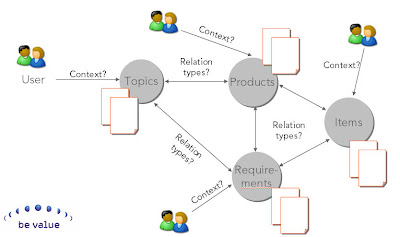
Just like technical writers, ICT Architects face the challenge to describe platforms, systems and solutions from a business point of view. But where there seems to lack a standard for technical writers, ICT Architects have the luxury of having frameworks like TOGAF and notation methods like Archimate to help them do their work. Function-oriented versus user-oriented documentation No doubt that there are still technical writers out there who don't agree with me, but to me it is clear that a user-oriented approach to documentation is the way to go. So if I am talking about making documentation from a business point of view, I am in fact talking about creating a documentation solution that fits the user's needs. Whether or not this is a printed book, a website, embedded on-line help or a combination of all these, doesn't make a difference, as long as the presentation form is chosen from a user's point of view. Where to start? We all know the feeling when we accept a new pr...

About knowledge modelling: Why do we need it?

Image
In my article in ISTC's Communicator (Autumn 2007) I explained that developing more effective information products asks for a knowledge-driven approach to communication. This knowledge-driven approach requires first of all that we offer the knowledge needed in a usable and understandable way, in line with the user’s knowledge and level of experience. The second requirement is that we should offer our users the right knowledge - from the enormous amount of available knowledge – at the right time. New semantic technology provides us with the opportunity to support our users in interpreting information within their context. The most important characteristics of these solutions are: non-hierarchical navigation: presents a mind map of the information, with different types of links making it possible to browse quickly through related topics and offering different points of view to different types of users decision trees: help users to make complex decisions by asking them simple question...

Be Informed announces international release

Image
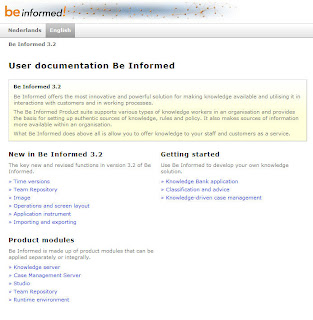
Be Informed offers a solution for publishing the same information — witt one model set and multiple content sources — to different media, in different formats and for several audiences. One of the disadvantages of the toolset - for international audiences - was that untill now all Be Informed releases were targeted at a Dutch user group, only containing on-line help and user assistance in Dutch. Be Informed hired me to produce a new on-line help system for their product suite, featuring both English and Dutch documentation. With release 3.2.4 the first version of this on-line help - with both function related help and some task related guidance - will be available. The upcoming months a configuration wizard and step by step guidances will be added to the documentation. The international release of Be Informed is scheduled to be launched on the 10th of December 2007. The on-line help will also be released on a website. I will come back to this as soon as it is available and provide you ...

New Machinery Directive as of 2010

Image
The Machinery Directive(MD) sets out safety requirements for new machines, assemblies of machines, interchangeable equipment and safety components, which must be met before these products can be traded within the European Economic Area. As of the 29th December 2009 the provisions of the new Machine Directive (2006/42/EC) will be applicable. This new Machine Directive includes some modifications to the essential health and safety requirements. An important aspect within the Machine Directive is the product documentation. Within the new Machine Directive the traceability of documentation becomes more important than ever. Manufacturers must keep the EC declaration of conformity and declaration of incorporation for a period of at least 10 years from the last date of manufacture. The focus will be on the whole lifecycle of products and its documentation, with special emphasis on operational health and safety issues. Documentation specialists now face the challenge of creating documentatio...