Posts

Showing posts with the label online help

From flexible content to digital knowledge

Image
Digital technology has allowed the documentation process to evolve from single document-centric to single source-centric: From creating individual manuals to creating re-usable chunks of information for a series of product and document types through various channels. Figure 1. Documentation evolved from document centric to single source centric Example A manufacturer of agricultural machines needed a complete line of documentation for its new type of harvester. In a document-centric approach, this would mean having one technical writer create the user documentation, another writer create the service manual and a third create the on-line help. In the best case they would copy chapters or paragraphs from one manual to the other. All of these documentation types would need to be reviewed by hand and individually updated when the harvester’s features changed, or new rules for its safe operation were implemented. In a single source environment, multiple writers work on discrete top...

Get documentation superpowers: Send me (a chapter of or instruction from) your documentation

As announced on several social media, I will demonstrate how we can use semantic technology to create process-driven documentation at the STC Summit 2013 in Atlanta.  I will do this by live modeling with a semantic tool set. Now I could do this with a predefined demo set, but what's the fun of that? So I would like to invite you to send a delimited instruction - this could be a chapter from one of your manuals - by uploading it to our server. From the uploaded manuals, I will select one or more to be modeled out.  As the models in the semantic environment are instantly executable, we can watch the documentation develop, change the models and review the results in a web browser. Wouldn't it be cool to see your documentation modeled out on the large screen at the STC Summit? When: May 6th, 2:00 pm (EDT) Where:   Hanover FG, Hyatt Regency Atlanta - Track my session Level: Advanced Uploading your file   Go to http://info.beinformed.com/stc13-upload a...

Improving product and brand engagement

Image
Instruction manuals, users guides, and other types of documentation have always been the way manufacturers distributed the how-to information about their products to customers, as well as sales and support staff and other employees. This kind of catch-all, one-size document forces every user to sift through irrelevant information, applying their own context to find solutions to their problems. Even when they are successful, users remember the experience as painful and tedious. What if you could take each individual user by the hand and guide them through the product, showing only what is relevant in their situation, immediately answering their questions and helping them make decisions and choices? Seamlessly effective, customized support would improve the user’s experience of the product and help them to feel engaged by the product and its brand. Product and brand engagement Product and brand engagement is – a partly emotional, partly rational – process of forming an attachment...

Documentation 3.0

In my last blog I explained how we can distinguish three phases in the development of documentation. The first phase was a very product centric one, while in the second phase we see a more process driven approach. Re-use gets more and more important as is collaboration with other writers. But what about the users? How do they benefit from this move to single sourcing? Sure, creating and translating documentation becomes cheaper and easier to manage, but having documentation in your own language is for most people normal and not seen as a usability feature. And then there is the issue with information overload. Maybe we should ask our users what information they need, instead of just providing them with everything we want them to know. To really help our users, we should move on from our process centric approach to a more customer-centric one. A customer-centric approach Documentation 3.0 is all about offering the right documentation at the right time. It is customer-centric, which mea...

From product centric to process centric documentation

The trends in documentation of the past 20 years are under heavy influence of the development of internet technology. Like with the web – where we distinguish between Web 1.0, Web 2.0 and 3.0 - we can see three phases in documentation. Product centric documentation The first phase is the phase in which we technical communicators worked with tools like Pagemaker, QuarkXPress or Framemaker. In this phase we are very much focussed on a single product and there is a constant struggle between task and function based documentation. If our customer needs a manual for a product, we write one – as an isolated process. Our focus is on the product and generic audience groups and not on things like re-use or efficient use of available information. Compare it to the story of the little prince, where the author makes three drawings of a sheep – each sheep could be a version of a product; with us technical communicators writing a separate manual for every version. Sure we see the similarities and do ...

Lessons learned from Documenting Product Development

A couple of weeks ago I started really enthusiastic with structuring the product requirements and product specifications of my customer's products. The goal of my work was to create a knowledge bank in which the audience can see both the product requirements and the relevant specifications next to each other. Last week I have finished the knowledge bank and presented it to the product architects. What did I learn from this project? Don't use your documentation project to restructure the whole organization First of all: it is impossible to capture the whole world in just one set of models. When you have to think of a documentation solution for a whole organization, it is tempting to restructure everything into one consistent overall structure. The truth is that in an ideal world this would be an excellent solution. In the real world you can't just change everything to get the desired result. Make a series of models for every single department or organizational unit that has ...

Technical writers as information integrators

Image
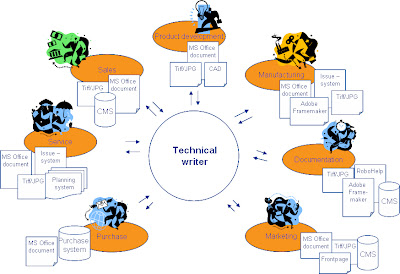
In an earlier post, I compared my work as a technical writer with Island hopping: going from one island to another. The truth is that to perform our job well we need information from different sources within an organization. And on the other hand people from different parts of the organization have a need for our skills when it comes to writing and presenting information. In a way we therefor function as information integrator within the organization: gathering information from different platforms and sources and creating output for different depatments (internal customers) and in different formats. As an example: When I created the documentation for my current customer, I gathered information about the product from different deparments and developed the on-line help. As a result, the Sales department became aware of my presence, noticed the quality of the information and asked me to create the Sales information. Currently I am working on a structure for the product specifications. In ...

About knowledge modelling: simple hierarchical models

Image
Last time, we have discussed what the benefits of knowledge modelling are. Now it is time, to take a first look at knowledge modelling, starting with a simple hierarchical model: As technical writers we are used to work with these kind of content structures, as illustrated above. This is the type of structure we not only use in manuals, but also in most on-line help systems and even websites. In this example we see two levels of information. When we would put this content structure in a graphical model it would look like this: All content elements - we call them 'concepts' in a knowledge model - are related to the next level with a relation of the type 'Subtheme of'. This type of knowledge model is very suitable for navigating and is supported by a large group of documentation, Help and website tools. Another very common knowledge model is the taxonomy. This type of knowledge model shows classes of concepts and their sub-types. All relationships in the model are of the ...

Be Informed announces international release

Image
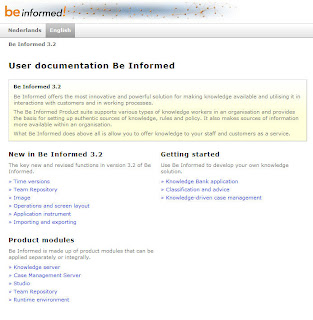
Be Informed offers a solution for publishing the same information — witt one model set and multiple content sources — to different media, in different formats and for several audiences. One of the disadvantages of the toolset - for international audiences - was that untill now all Be Informed releases were targeted at a Dutch user group, only containing on-line help and user assistance in Dutch. Be Informed hired me to produce a new on-line help system for their product suite, featuring both English and Dutch documentation. With release 3.2.4 the first version of this on-line help - with both function related help and some task related guidance - will be available. The upcoming months a configuration wizard and step by step guidances will be added to the documentation. The international release of Be Informed is scheduled to be launched on the 10th of December 2007. The on-line help will also be released on a website. I will come back to this as soon as it is available and provide you ...