Posts

Showing posts with the label instructions

Smart devices for cool people: We don’t need no documentation

Image
I have bought a new coffee machine this weekend. Not that the old machine stopped working, I just didn’t like its coffee anymore. The old coffee machine was one of those Senseo machines, very cool 10 years ago, but not really living up to the expectations when it came to the quality of the coffee. Plus that you really needed to apologize up front to visitors for having such an example of ancient technology in your kitchen. But then the new machine: it is cool, it is white, it is small and it makes excellent coffee. Even better: by buying it I became a member of an exclusive society of coffee enjoyers, amongst who George Clooney is probably the best known. So with high anticipation I unpacked the machine. First came the exclusive black menu card holder, containing a menu card with an overview of all the special flavors that were now within my reach and an invitation to become a member of this exclusive coffee drinkers club. Next came the starters set with 16 exclusive coffee cups...

From flexible content to digital knowledge

Image
Digital technology has allowed the documentation process to evolve from single document-centric to single source-centric: From creating individual manuals to creating re-usable chunks of information for a series of product and document types through various channels. Figure 1. Documentation evolved from document centric to single source centric Example A manufacturer of agricultural machines needed a complete line of documentation for its new type of harvester. In a document-centric approach, this would mean having one technical writer create the user documentation, another writer create the service manual and a third create the on-line help. In the best case they would copy chapters or paragraphs from one manual to the other. All of these documentation types would need to be reviewed by hand and individually updated when the harvester’s features changed, or new rules for its safe operation were implemented. In a single source environment, multiple writers work on discrete top...

Get documentation superpowers: Send me (a chapter of or instruction from) your documentation

As announced on several social media, I will demonstrate how we can use semantic technology to create process-driven documentation at the STC Summit 2013 in Atlanta.  I will do this by live modeling with a semantic tool set. Now I could do this with a predefined demo set, but what's the fun of that? So I would like to invite you to send a delimited instruction - this could be a chapter from one of your manuals - by uploading it to our server. From the uploaded manuals, I will select one or more to be modeled out.  As the models in the semantic environment are instantly executable, we can watch the documentation develop, change the models and review the results in a web browser. Wouldn't it be cool to see your documentation modeled out on the large screen at the STC Summit? When: May 6th, 2:00 pm (EDT) Where:   Hanover FG, Hyatt Regency Atlanta - Track my session Level: Advanced Uploading your file   Go to http://info.beinformed.com/stc13-upload a...

Lessons learned from Documenting Product Development

A couple of weeks ago I started really enthusiastic with structuring the product requirements and product specifications of my customer's products. The goal of my work was to create a knowledge bank in which the audience can see both the product requirements and the relevant specifications next to each other. Last week I have finished the knowledge bank and presented it to the product architects. What did I learn from this project? Don't use your documentation project to restructure the whole organization First of all: it is impossible to capture the whole world in just one set of models. When you have to think of a documentation solution for a whole organization, it is tempting to restructure everything into one consistent overall structure. The truth is that in an ideal world this would be an excellent solution. In the real world you can't just change everything to get the desired result. Make a series of models for every single department or organizational unit that has ...

Technical writers as information integrators

Image
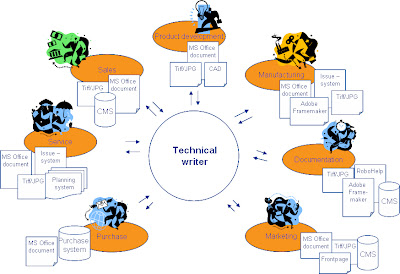
In an earlier post, I compared my work as a technical writer with Island hopping: going from one island to another. The truth is that to perform our job well we need information from different sources within an organization. And on the other hand people from different parts of the organization have a need for our skills when it comes to writing and presenting information. In a way we therefor function as information integrator within the organization: gathering information from different platforms and sources and creating output for different depatments (internal customers) and in different formats. As an example: When I created the documentation for my current customer, I gathered information about the product from different deparments and developed the on-line help. As a result, the Sales department became aware of my presence, noticed the quality of the information and asked me to create the Sales information. Currently I am working on a structure for the product specifications. In ...

New Machinery Directive as of 2010

Image
The Machinery Directive(MD) sets out safety requirements for new machines, assemblies of machines, interchangeable equipment and safety components, which must be met before these products can be traded within the European Economic Area. As of the 29th December 2009 the provisions of the new Machine Directive (2006/42/EC) will be applicable. This new Machine Directive includes some modifications to the essential health and safety requirements. An important aspect within the Machine Directive is the product documentation. Within the new Machine Directive the traceability of documentation becomes more important than ever. Manufacturers must keep the EC declaration of conformity and declaration of incorporation for a period of at least 10 years from the last date of manufacture. The focus will be on the whole lifecycle of products and its documentation, with special emphasis on operational health and safety issues. Documentation specialists now face the challenge of creating documentatio...