Posts

How making videos changed my writing process

Lessons learned from working on instructional videos For a technical communicator, writing instructions is often still the core business. At least, that is how it was for me. No matter the changes in presentation - printed documentation versus smart documentation - the process of creating the documentation remained for me unchanged over the years. Until recently... This is what my process used to look like: Define the goal, audience, and context Analyze processes and activities Create the overall documentation model Write! Test and improve A line of tutorials At Be Informed I am responsible for Be Free, the community of Be Informed users. We offer the a free version of our semantic toolbox  - the Personal Edition - to users worldwide. To support these users I have developed a line of short tutorials that support users in performing basic tasks like setting up the work environment, start modeling and use domain specific modeling constructions. These instructions ar...
STC Web Seminar "Using semantic technology to create process-driven documentation"

Image
For most product manufacturers, delivering adequate documentation is a constant challenge. The increasing complexity of products and the stricter regulations for product documentation often lead to extensive documentation sets with 500+ pages manuals online or in print. The question is: how effective is all this documentation? During the STC Summit 2013 in Atlanta I have demonstrated how you can use semantic technology to create process-driven documentation. The session was well visited and evaluated, resulting in numerous questions on how writers could use this technology immediately in their own situation. For everyone that wasn't able to attend this session in Atlanta - and everyone that did attend it but wants to see it again - the Society for Technical Communication organizes the web seminar "Using semantic technology to create process-driven documentation". The session will be highly interactive, with plenty of opportunities to influence the modeling proc...

Technical writing = user community management

Technical communication has in my opinion never been limited to writing only. As I wrote before technical communicators can act as usability expert, business modelers and information architects. With the launch of Be Free, the, the worldwide community of Be Informed Personal Edition users, I find my self in a new role: managing the community. To do so, I write, teach and present, constantly adapting my outgoing information and message to the reactions that come from my community. Building up the community For years now I am writing and presenting about using semantic technology in a model-driven environment. This technology offers great advantages opposed to more traditional development methods and it also offers opportunities to create smarter documentation. One of the main obstacles in my story was always that in order to work with this technology, a company would have to invest in a full-blown implementation featuring both the workstation ánd the server side of the software. Wi...

Old Tech - New Tech (part 2)

Image
In my previous article, I described how I used a Card Method to gather input from my audience for a Smart Documentation solution. My approach for these sessions was: I prepared approximately 20 cards with topics from the current version of the system I invited 18 respondents for a 30 minutes session The sessions consisted of three parts: To start with, I asked every respondent to make five cards for the five topics that they would like to find on the new system. By narrowing it down to five, I encourage them to only write down the most important topics. At the end of this step I asked them to make categories of these five cards, each category forming a column on the table. In the next step I - one by one - gave them the prepared topics and asked the respondent to add them to an existing category or create a new category for it. When all cards were done, we reviewed the categories and made final adjustments In the final step, the respondent wrote down the labels for the categor...

Old Tech - New Tech

Image
Sometimes you need to fall back on the oldest technologies available to get the most out of the latest and greatest. This is also true when developing smart documentation. My current project involves the creation of a smart documentation solution for the Be Informed Business Process Platform (BPP). The documentation solution is targeted at users with various educations levels, different skills and experiences and with various roles in an organization or project. And to make things even more complex: the total set of documentation should at least cover all current versions of the BPP, the business solutions that are used on top of it and the implementation and project management methods used during implementation. Preparation  As mentioned in my white paper about creating smart documentation, the preparation for a smart documentation project - before writing the content - consists of the following steps: Define the goal, audience, and context: Clearly define the context, g...

Smart documentation revisited

Image
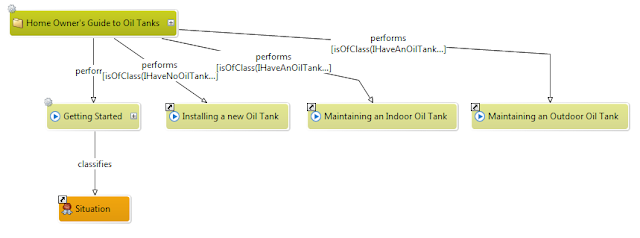
At the STC Summit 2013 in Atlanta, I demonstrated how we can create smart documentation by using semantic technology. The session was well visited and there were a lot of good questions. During the session I modeled live - together with the audience - on a smart maintenance manual for oil tanks. To me - being from a country where we don't know or use these kind of tanks next to our houses - this felt like the ultimate example, completely relying on the expertise of my audience. The demo The starting point was a very basic procedure, consisting of four main activities: In the first step we determine the situation. We start with a short situation description and then - instead of describing what possible situations there are and linking to the pages - we ask our users about their situation. As it is not relevant for people that don't own an oil tank yet to read the maintenance instructions, the first question we ask is whether or not the reader actually owns an oil tan...

Improve Product and Brand engagement through smart documentation

Image
There is no doubt that the introduction of semantic technology in documentation, will change the way we create our documentation. Increased product and brand engagement Figure 1. Happier users Smarter documentation will lead to happier users, who reach their goals faster and with less frustration. Documentation that exactly responds to individuals will enhance perception of the product and the brand. Although positive feedback travels less quickly on the social media than negative feedback, it will not only impact the product and brand engagement of current customers but also motivate potential customers to take a serious look at your product. It will also influence your image and reputation as a technical communicator in the market and the value you offer to your contractors or managers. In this perspective technical communication will become a profit center instead of a cost center.   Increased documentation engagement Figure 2. Continuity of work Lookin...