Posts

Lessons learned from Documenting Product Development

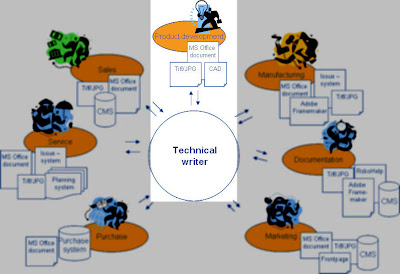
A couple of weeks ago I started really enthusiastic with structuring the product requirements and product specifications of my customer's products. The goal of my work was to create a knowledge bank in which the audience can see both the product requirements and the relevant specifications next to each other. Last week I have finished the knowledge bank and presented it to the product architects. What did I learn from this project? Don't use your documentation project to restructure the whole organization First of all: it is impossible to capture the whole world in just one set of models. When you have to think of a documentation solution for a whole organization, it is tempting to restructure everything into one consistent overall structure. The truth is that in an ideal world this would be an excellent solution. In the real world you can't just change everything to get the desired result. Make a series of models for every single department or organizational unit that has ...

Article "How knowledge becomes usable" in Communicator

Image
In my article "How knowledge becomes usable" - published in the Winter edition of Communicator - I explain how you can incorporate knowledge-driven design in information products. The Communicator is the quarterly journal of the Institute of Scientific and Technical Communicators (ISTC). The article is a follow-up on my presentation at the ISTC Conference 2007 in Liverpool. If you are a member or a subscriber of Communicator, you automatically receive this issue. Otherwise, if there is something of interest to you, contact the ISTC Office to purchase a copy. The ISTC is the largest UK-based society for professional communicators. If you are a technical communicator and working in the UK - or Europe in general - I can strongly recommend membership of the ISTC. Look for more information on their website: www.istc.org.uk .

Documenting product development

Image
I mentioned in my last article of 2007, that as a technical writer you can expect to be asked for several kinds of documentation within your organization. Recently I started to structure the product requirements and product specifications of my customer's products. The intended audience consists of the product manager and product architects on the one hand and the developers on the other hand. The goal of my work is to create a knowledge bank in which the audience can see both the product requirements and the relevant specifications next to each other. At this moment there are two types of documents: A functional requirements document: This is a 27 pages long Word document, including some illustrations. It has a thematical structure. This document is written and edited by two product architects. Component design documents: These are detailed functional and technical descriptions of parts of the product, first written by developers and then edited by two functional designers. The co...

Technical writers as information integrators

Image
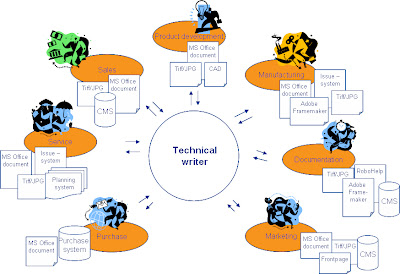
In an earlier post, I compared my work as a technical writer with Island hopping: going from one island to another. The truth is that to perform our job well we need information from different sources within an organization. And on the other hand people from different parts of the organization have a need for our skills when it comes to writing and presenting information. In a way we therefor function as information integrator within the organization: gathering information from different platforms and sources and creating output for different depatments (internal customers) and in different formats. As an example: When I created the documentation for my current customer, I gathered information about the product from different deparments and developed the on-line help. As a result, the Sales department became aware of my presence, noticed the quality of the information and asked me to create the Sales information. Currently I am working on a structure for the product specifications. In ...

New article in Intercom

Image
In March 2008 my new article "The Flexible Intranet" will be published in Intercom, the monthly magazine of the Society for Technical Communication. In this article I will examine the typical problems found in a corporate intranet site and demonstrate how knowledge-driven design can improve the effectiveness of intranet sites. In the article I use the example of a helpdesk that delivers support for mobile phones. With this example I will demonstrate how an effective intranet site guides the helpdesk employee toward the information and presents the answers to the questions they are confronted with. Saul Carliner, an internationally known expert on technical communication, contributed to this article. Intercom, the magazine of the Society for Technical Communication , is published to provide examples and applications of technical communication that will promote its readers' professional development. Intercom is published for the benefit of STC members, each of whom receives...

Island hopper

You probably recognize this situation: You have to write a manual, product leaflet or text for a website and you need some information about this specific topic. The information about the topic is available within the organization, but you have to gather it from different people from several departments. And they don't like you messing with their content. They want to keep control over it. Sometimes our job as technical writer is like moving from one island to the other, building bridges and demolishing borders. If you - for instance - need to describe a product, you first travel to the island of the product developers to gather the product specifications. Next you can go to the marketing department to get some of their sales statements about the product and you might want to hop to the Service department to get the ins and outs of their servicing approach. Does this sound familiar to you? I have found this situation in all kinds of organizations. In some cases these organizations ...

About knowledge modelling: attributes

Image
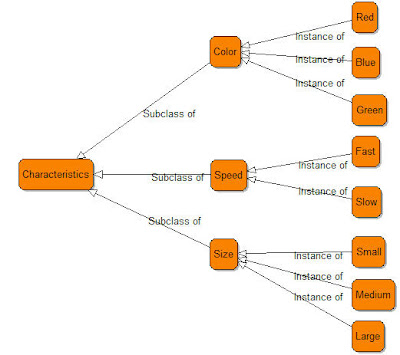
In the previous entry, I demonstrated three types of knowledge models. These models can help us structure the information we acquire from functional specifications, subject matter experts, the marketing department and - in some cases - our own observations. When combined they offer us different paths to our information. We have looked at: Thematical models Taxonomies / concept models Composition models A fourth model is called the Attribute model . An attribute model shows attributes and values: colors, specific characteristics, etc. An example is shown below: With the attribute model we can describe all possible characteristics of a product range and link them to the actual products. This makes it possible to make an overview of all variations within a productrange. The models can help us choose between products. Example: You call the service desk of the manufacturer of your TFT screen Service desk employee: "Do you know the exact product type?" You: "I am not sure, I c...